System reliability for AI-integrated organisations.
MindXO conducts original research on the integration complexity and architectural impedance mismatch that emerge when probabilistic AI systems operate alongside deterministic legacy infrastructure, rules engines, and automated decision pipelines.
Individually, every system performs within specification. But when AI-generated outputs flow across system boundaries, locally valid decisions can compound into environment-level drift undermining system reliability, decision quality, and business continuity without triggering a single alert.
The research programme addresses a failure class that existing MLOps tools and brittle semantic contracts cannot fix: environment-level drift caused by locally valid AI outputs that carry unresolved semantic ambiguity across system boundaries.
Our work focuses on a class of failure called Ambiguity-Bearing Outputs (ABO): AI outputs that pass all local validity checks but carry enough semantic latitude to trigger unintended interpretations when consumed by downstream systems (Ayada, 2026).
This is not hallucination. It is not data drift. It is a structural consequence of deploying AI in environments where outputs cross system boundaries at machine speed and where the meaning of an output changes at every interface.
The environment in which this propagation occurs (the Interconnected Systems Environment, or ISE), derive a containment architecture; the Inter-System Coherence & Integrity Layer (ISCIL). ISCIL detects and dampens drift at system boundaries before it compounds into a business continuity event.
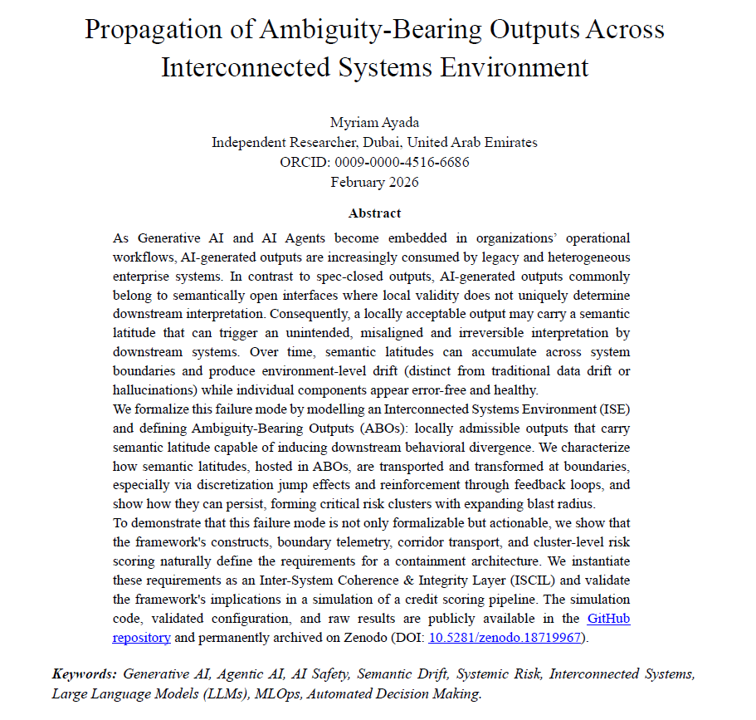
Propagation of Ambiguity-Bearing Outputs Across Interconnected Systems Environment.
Ayada, M. (March 2026).
Summary: As AI-generated outputs flow through enterprise pipelines, from LLM-based assessments into rules engines, scoring models, and others, a failure mode emerges that operates below the threshold of existing monitoring. Outputs that are locally valid but semantically underdetermined can trigger unintended interpretations at system boundaries, producing environment-level drift while every component appears healthy.
This paper formalises this failure mode, introduces Ambiguity-Bearing Outputs (ABO) and Semantic Latitude Vectors (SLV), models the propagation environment as an Interconnected Systems Environment (ISE), and derives ISCIL: a corridor-level containment architecture validated in simulation with 100% drift recovery at 6.5% operational overhead.
Resources:
Preprint: https://papers.ssrn.com/sol3/papers.cfm?abstract_id=6383259
DOI: https://dx.doi.org/10.2139/ssrn.6383259
Code: github.com/Myr-Aya/ISE_simulator
Archive: Zenodo DOI 10.5281/zenodo.18719967
Citation: BibTeX available on GitHub
The paper introduces three concepts for organisation AI Risk Management and Governance:
Ambiguity-Bearing Outputs (ABO). AI outputs that pass local validity checks but carry enough semantic latitude to trigger unintended downstream behaviour. Unlike hallucinations, ABOs are locally correct. Unlike data drift, ABOs can cause environment-level drift even when input distributions remain stable. ABOs are the structural root cause of what the industry frequently misdiagnoses as semantic drift or unavoidable LLM non-determinism.
Interconnected Systems Environment (ISE). A directed-graph framework modelling how AI outputs propagate through enterprise systems. Nodes are systems; edges are corridors: boundaries where outputs become inputs for the next system. ISCIL maps the exact corridors where the AI-to-legacy impedance mismatch causes downstream format and logic failures.
Inter-System Coherence & Integrity Layer (ISCIL). A containment architecture operating at system boundaries. Rather than relying on rigid semantic contracts that attempt to force absolute determinism, ISCIL allows the environment to absorb semantic ambiguity safely. In simulation of acredit scoring pipeline across 1,200 timesteps, ISCIL eliminated all excess defaults with 6.5% overhead and detected drift approximately 40 time steps faster than outcome-based monitoring (Ayada, 2026).
Glossary of Terms. Definitive reference for ABO, ISE, ISCIL, Semantic Latitude, and all coined concepts.
In a simulation that replicates a realistic AI-integrated underwriting pipeline, e.g. four interconnected systems processing loan applications over 1,200 decision cycles, we measured what happens when a single AI output carries just enough ambiguity to pass local checks but shift downstream behaviour. Below the main results:
1. A +0.1 pp approval rate shift, invisible to component monitoring, produced +2.2% excess defaults and 2.5% P&L damage across 1,200 timesteps.
2. No individual system flagged an error. Calibration divergence persisted 400 timesteps after the ambiguity source ceased.
3. ISCIL detected drift ~40 timesteps faster than outcome monitoring, intervened for 78/1,200 timesteps (6.5% overhead), achieved 100% default recovery.
Organisations deploying AI at scale face a governance blind spot. Current frameworks, from internal model risk management to external regulatory requirements, focus on individual AI systems: is the model accurate, explainable, auditable?
This is necessary but not sufficient.
When AI outputs flow into rules engines, scoring pipelines, and feedback loops, the risk shifts from model-level to environment-level. A credit scoring model that is individually correct can still contribute to portfolio drift when its outputs are systematically reinterpreted at downstream boundaries. No component fails. No threshold is breached. But system reliability degrades, decision quality erodes, and business continuity is compromised silently.
Financial institutions are particularly exposed. AI is being deployed in credit scoring, fraud detection, customer onboarding, and regulatory reporting often into hybrid architectures where AI-powered systems sit alongside legacy core banking platforms and human-in-the-loop review workflows. These are precisely the environments where inter-system risk materialises.
Regulators around the world are beginning to respond. The Dubai DIFC's Regulation 10 now governs autonomous and semi-autonomous systems. The CBUAE mandates explainable and auditable AI in financial services. Bahrain's CBB has integrated technology risk expectations into its supervisory rulebook. The Monetary Authority of Singapore has published Guidelines for Risk Management Framework. But these frameworks are yet address the risk that arises between systems i.e. when a locally valid AI output crosses a boundary and triggers unintended downstream behaviour.
Our research provides the analytical foundation for closing this gap: a formal model of inter-system risk (ISE), a containment architecture that operates at system boundaries (ISCIL), and simulation evidence demonstrating that boundary-level monitoring detects drift 40 timesteps faster than outcome-based approaches: the difference between early intervention and a business continuity event.